
The seller is retiring, and the building is for sale too. How you answer that in the first month of a practice purchase will still be shaping your balance sheet in fifteen years.
Most buyers treat the building as a second, smaller decision. It is neither. It is a separate loan on different terms, and the order you take them in determines whether you get both.
This comes up constantly in professional services banking: dentists, veterinarians, and optometrists across our footprint. The generation that built these practices in the 1980s and 1990s tended to buy their buildings, so when they sell, both assets reach the market at once.
A practice and a building are two different loans
They get talked about as one transaction because they close the same day. Underwriting sees two credits that behave nothing alike.

The practice loan is a cash flow loan. It is sized against what the practice earns, not against what the seller is asking, and the collateral is equipment, receivables, and a patient list that walks out the door if the transition goes badly. That is why practice debt amortizes fast, commonly over 7 to 10 years.
The building loan is a real estate loan. It is secured by an appraised asset that exists whether or not the practice thrives, so it amortizes over 15 to 25 years and prices tighter. We wrote about how lenders evaluate the property side in our guide to commercial real estate underwriting, and most of it applies here.
The practical consequence: the same dollar costs far more per month inside the practice loan than inside the building loan. Which is exactly why the split matters.
Why maximum leverage on the practice can cost you the building
Some lenders will finance a practice acquisition at very high advance rates and add working capital on top. That is a real option, and for some buyers the right one. Worth understanding the trade.
Two things happen when the practice loan is stretched to its limit. The payment rises, consuming cash flow a second loan would need. And no cash goes in, so there is no equity left for the down payment the building will ask for.
A building purchase is not a zero equity transaction. Conventional owner occupied financing typically expects meaningful money down, and the SBA 7(a) and 504 programs have their own equity requirements, with 504 structured at roughly 50 percent bank, 40 percent CDC, and 10 percent from you. On a $650,000 building, 10 percent is $65,000. A buyer who put nothing into the practice generally does not have it.
So the question is not whether to buy the building. It is whether the practice loan leaves the door open.
What the numbers look like: a Ramsey example
A note on these figures. The scenario below is a composite, built to show how the two structures behave. It is not a customer, not a transaction we have financed, and not a quote. The rates are round numbers chosen to make the arithmetic easy to follow.
A dentist is buying a practice in Ramsey. Practice price $900,000. The building it operates from is listed at $650,000. After the seller's compensation is normalized and the buyer's draw is set, roughly $235,000 a year is available to service debt.
| Buyer puts equity in | Practice financed to the limit | |
|---|---|---|
| Practice loan | $900,000, 10 years, 6.75% example | $1,050,000 with working capital, 10 years, 6.75% example |
| Annual practice payment | $124,010 | $144,678 |
| Building loan | $650,000, 20 year amortization, 6.25% example | Same |
| Annual building payment | $57,012 | $57,012 |
| Combined debt service | $181,022 | $201,690 |
| Coverage on $235,000 | 1.30 | 1.17 |
Lenders generally want coverage of about 1.20 or better. In the left column both loans clear. In the right column the practice closed beautifully and the building loan does not qualify, before anyone discusses the down payment the buyer no longer has.
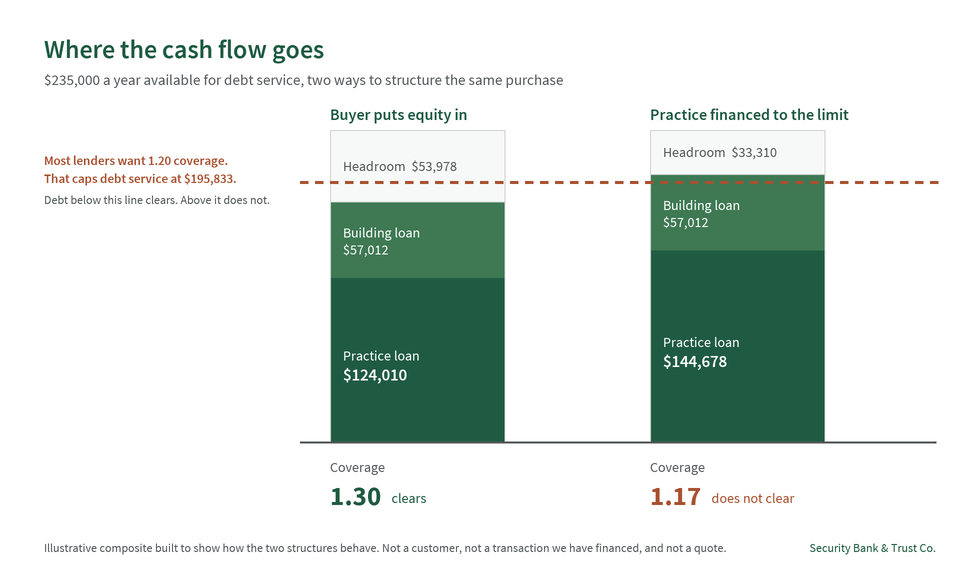
Same practice. Same building. A different answer, decided entirely by how the first loan was structured.
If you want to see the two structures side by side with your own numbers, our lending team can model it with you before you sign a letter of intent.
SBA 7(a), SBA 504, or conventional
Three paths show up in practice deals, and buyers often use more than one.
SBA 7(a)
Financing up to $5 million, with terms generally up to 10 years for the business portion and up to 25 years on the portion backed by real estate. It is the common route when the practice and the building are bought together, because one loan can cover both and the real estate portion stretches the amortization.
SBA 504
Built for owner occupied real estate and long lived equipment. Roughly 50 percent from the bank, 40 percent from a certified development company, and 10 percent equity from you, with certain projects calling for up to 20 percent. It is often the better fit when the building is the larger piece or when you are buying it in a later year.
Conventional
Fewer documentation requirements and a faster close, with more equity expected. For an established buyer with cash, conventional is frequently the cleanest path on the real estate. Our overview of how to get a business loan in Minnesota walks through what each route asks for.
When leasing is the better call
Buying the building is not automatically right, and a lender telling you otherwise is selling you a loan.
Leasing usually wins in three situations. When the space is wrong for where the practice is going. When the location sits inside a retail center or medical complex you could not buy a piece of anyway, common in Eden Prairie and Minnetonka. And when the first two years after a transition are uncertain, because liquidity is worth more than equity while you are still learning whether the hygiene schedule holds.
What buyers often do instead is negotiate a purchase option into the lease at a set price, then exercise it in year three once the practice loan has amortized down. That gets you the building without betting the transition on it.
What we look at on the real estate side
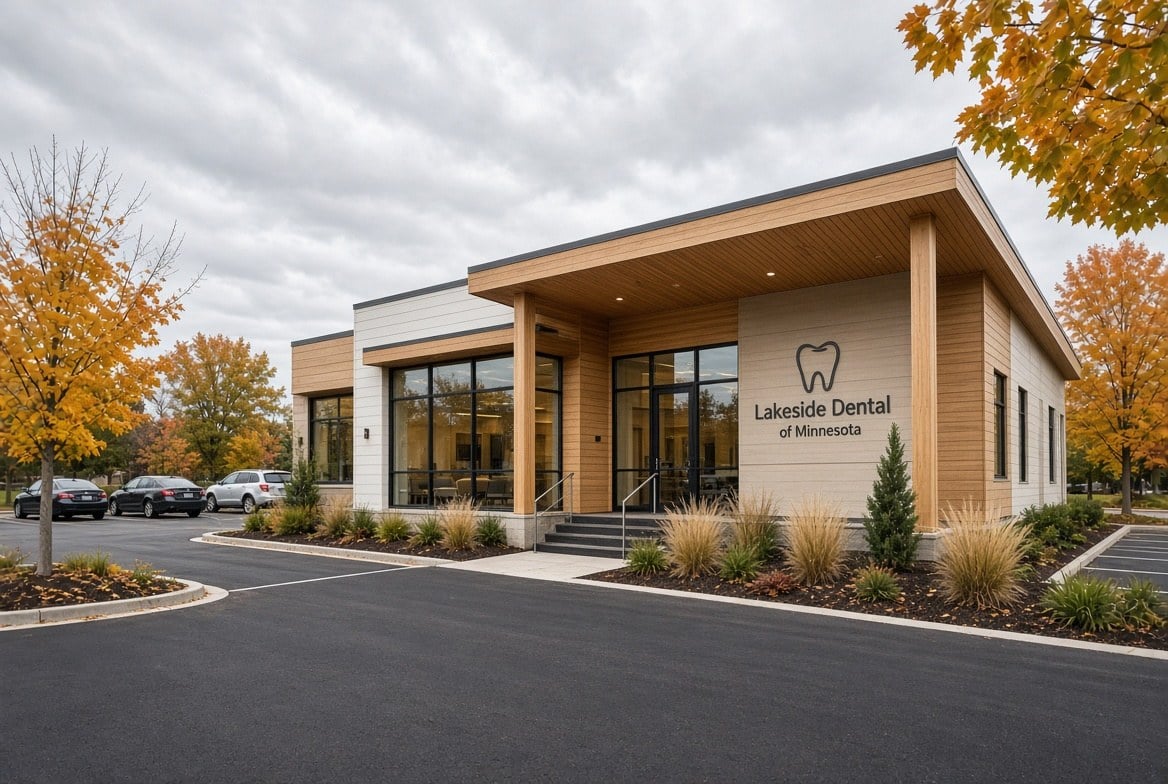
The building underwrites on its own merits, not on the practice's enthusiasm for it.
- Appraised value against the purchase price. Sellers who own both sometimes price the building generously because the practice number is where they are focused. The appraisal decides what we lend against.
- Rent the property would command from anyone. If your practice left, what would the space lease for? That figure, not what you pay yourself, drives value.
- Condition and remaining life of the mechanicals. A dental building from the 1990s still running its original rooftop units has a capital number attached, and it belongs in the model at closing rather than in year two.
- Entity structure. Buyers commonly hold the real estate in a separate entity from the practice, with a written lease between them. It keeps the two assets separable when you sell, and is easier to set up at the start than to unwind later.
- Environmental and access review on older commercial parcels, often the long pole in the closing schedule.
Much of this parallels what we cover in investment real estate financing, with the difference that you are your own tenant.
Why the local piece matters here
A national platform can underwrite a practice from anywhere, because collections data looks the same everywhere. Real estate does not.
What a dental building is worth in Chaska is not what comparable square footage is worth in Cambridge, and that difference is not in any national model. Neither is whether the parcel behind it is about to be rezoned, or which contractor can plumb four operatories before your start date.
It also means both loans are decided by people you can meet, and the structure gets built once rather than the second lender inheriting what the first one left behind.

"I love having everything in one place. I personally know the people I work with for the loans, so it always feels personal, and like they have my best interest in mind."
Frequently asked questions
Should I buy the building when I buy a dental practice?
It depends on whether the space fits the practice you intend to run in ten years and whether the combined debt service still covers comfortably. When both are true, owning the building turns your largest fixed expense into equity and gives you an asset you can sell separately from the practice. When either is in doubt, leasing with a purchase option is usually the better first move.
Can I finance 100 percent of a dental practice purchase?
Some lenders do offer very high advance rates on practice acquisitions. The consideration is what it leaves you with afterward: a higher monthly payment and no equity available for the building, which can put the real estate out of reach for several years. Buyers weighing both assets often choose a structure that preserves capacity rather than one that maximizes proceeds.
How much down payment do I need for a dental office building in Minnesota?
It varies by program and by deal. SBA 504 is commonly structured with 10 percent equity from the borrower, rising to as much as 20 percent on certain specialized projects, while conventional owner occupied financing generally expects more. The appraisal, the condition of the building, and the strength of the practice cash flow all move the number.
Can I buy the practice now and the building later?
Yes, and it is a common sequence. The two things that make it work are a written purchase option in your lease at a price agreed up front, and a practice loan structured so that your coverage still supports a second loan in year three. Both are far easier to arrange before closing than after.
Does student loan debt stop me from buying a practice?
Not by itself. Lenders look at total obligations including student debt, but a practice with durable collections and a clean transition plan carries most of the analysis. What matters more is the quality of the earnings and how the transition is structured, which is the same ground covered in our due diligence checklist for small business acquisitions.
Keep reading
- Business acquisition loan, how we size and structure a purchase
- Small business loans, lines of credit, term debt, and equipment financing
- Professional services banking, for practices, firms, and their owners
- Understanding commercial real estate underwriting, what the property side of the file looks like
- Why Minnesota business owners bank with us
- Locations, all 21 branches across 18 Minnesota communities
Have the conversation before the letter of intent
The structure is easiest to shape before anything is signed. If a practice is coming available and the building is part of the picture, the useful conversation happens while both are still on the table, not after the practice loan is committed. Bring the collections, the asking prices, and the lease if there is one.
Talk with a lender See how acquisition financing works
Growing, together.
All loan products are subject to credit approval. The rates, terms, and payment figures in this article are illustrative examples used to show how loan structures compare, are not offers or quotes, and do not reflect any particular borrower or transaction. SBA program terms are set by the U.S. Small Business Administration and are subject to change. This article is general information and does not constitute legal, tax, or accounting advice; please consult your attorney, CPA, or practice transition advisor about your own situation. Page last reviewed September 2026.